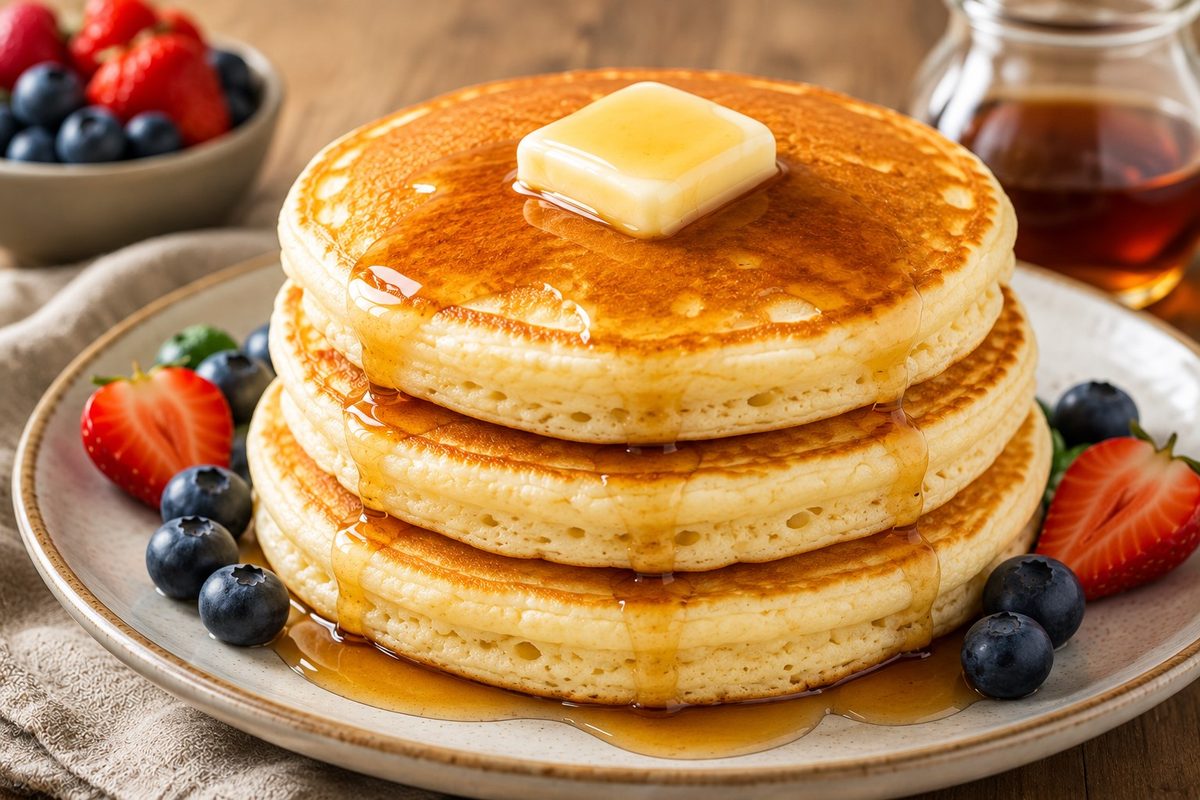
Pancakes turn out fluffy when air bubbles are created and then protected: fresh baking powder plus a baking soda and buttermilk reaction make the gas, a thick barely-mixed batter traps it, a ten-minute rest builds it up, and a properly preheated pan expands it before the crumb sets.
The method at a glance
Heat the pan on medium-low first. It needs five to eight minutes.
Whisk the dry ingredients. Whisk the wet ingredients separately.
Combine with about twelve folds. Stop while the batter is lumpy.
Rest the batter ten minutes. Do not stir it again.
Pour a scant 1/3 cup per pancake onto the lightly greased pan.
Flip once, when the surface bubbles break open and stay open.
Cook one to two minutes more. Never press the pancake down.
That is the whole recipe in seven lines. Everything below explains the why, which is what saves you when something goes wrong.
No buttermilk in the house? Stir 2 tablespoons of lemon juice or vinegar into 2 cups of milk, wait ten minutes, and carry on exactly as written. The batter rest and the pan preheat take ten minutes anyway, so it costs you nothing. The ten-minute buttermilk substitute →
The fair comparison
Buttermilk vs plain milk pancakes
Plenty of popular pancake recipes use plain milk, and the appeal is real: no special carton to buy. So why does this one ask for buttermilk, or its ten-minute stand-in? Because the acid does chemistry plain milk cannot. It fires the baking soda for extra lift, it tenderises the crumb by slowing gluten, and it browns the surface deeply before the inside dries out.
The same technique, two different liquids
Buttermilk (this recipe)
Plain milk version
Height
Tallest. The soda and acid reaction adds a second wave of lift.
Good with extra baking powder, but a shade shorter.
Texture
Tender and moist, fine crumb. Forgives slight overmixing.
Springier and a little drier. Less margin for error.
Flavour
Gentle tang. The diner pancake taste.
Milder and sweeter, closer to a boxed mix.
Browning
Deep, even gold at moderate heat.
Paler, which tempts you to overcook chasing colour.
Convenience
Needs buttermilk, or milk plus acid and ten minutes.
Wins if the fridge is truly bare of any acid.
Required tweak
None. The recipe as written.
Leave out the baking soda and use 1 tbsp baking powder. Soda with no acid tastes soapy.
The honest verdict: a plain-milk pancake made with good technique beats a buttermilk pancake made with bad technique every time. The twelve folds, the rest and the pan heat matter more than the liquid. But with technique equal, buttermilk wins on height, tenderness and colour, and the substitute costs ten unattended minutes. That is why the recipe is written the way it is, and why both paths are covered in full in
the no-buttermilk guide.
Twelve pancakes, one bowl, thirty-five minutes — and twenty of those are hands-off. They stay tall because of the ten-minute rest.
Why this page exists
Sixty batches to find what really matters
I spent years looking for a fluffy pancake recipe that actually worked. Mine were fine — edible, but flat and a bit tough. I thought the fix was a secret ingredient, so I tried them all. None of them worked.
What changed things was watching a diner cook. He mixed the batter badly and left lumps in it. He let it sit while he dealt with an order of eggs. And his pan had been warming long before I sat down. Three things I was getting wrong, and not one was an ingredient.
That is this recipe, tested over sixty batches on a normal home cooker.
The simple science
Why this fluffy pancake recipe works
Fluffy means trapped air. This batter makes it in three waves: when the buttermilk meets the baking soda, again during the rest, and biggest of all in the hot pan. Your only job is to protect those bubbles.
That is why stirring matters. Lots of stirring builds gluten, which turns pancakes chewy and stops them rising. A lumpy batter holds the air instead. The lumps soak up liquid while it rests and vanish in the pan.
The rest earns its ten minutes too. The batter thickens so it can hold its height, and the baking powder gets going before it hits the heat.
The number one mistake
Stirring until the batter is smooth. The moment you think a few more stirs and it will be perfect is the moment to stop. Count twelve folds and put the spatula down, even if dry flour is still showing.
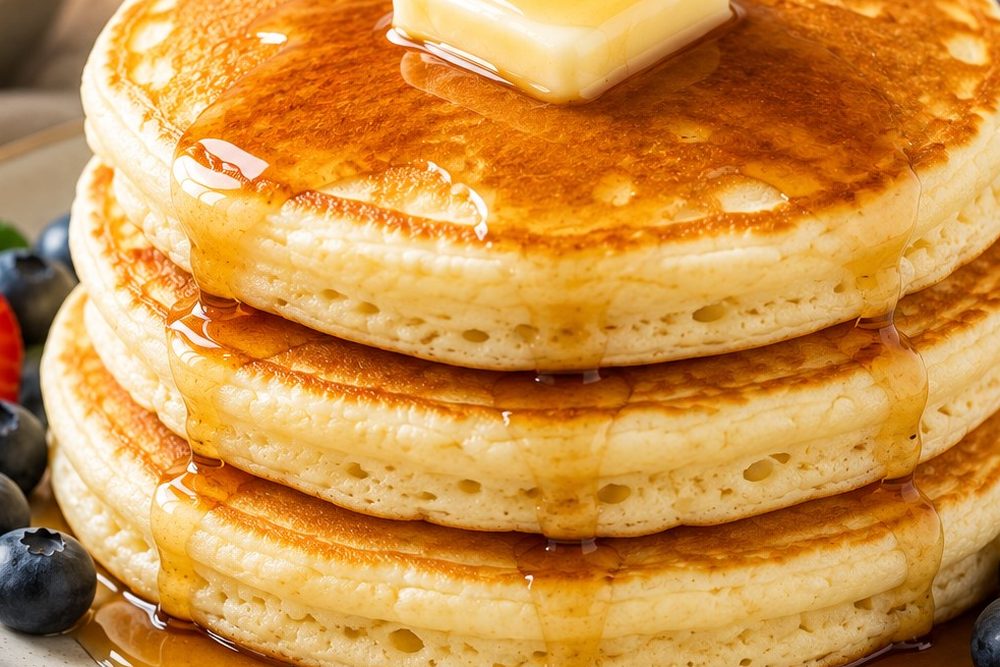
This is what the three waves look like from the inside: an open, uneven crumb full of trapped air. A smooth, overmixed batter gives you a tight, cakey one instead.
Before you start
Equipment: little is needed, but the pan matters
This recipe needs one big bowl, one jug, a whisk, a flexible spatula, a 1/3 cup measure and a pan. No mixer, and no scale unless you prefer grams. The only choice that genuinely changes your results is the pan.
Which pan for fluffy pancakes
Pan
Best for
Watch out for
Heat setting
Non-stick frying pan
Beginners. The most forgiving surface and the easiest release.
Thin pans run hot in the centre, so give it the full preheat.
Medium-low
Cast iron skillet
The best, most even browning once it settles.
Holds a lot of heat. Overshoots easily and recovers slowly.
One notch below medium-low
Electric griddle
Big batches. Four pancakes at once at one temperature.
Trust the water test over the dial, because dials drift.
190°C / 375°F
Avoid curved-bottom pans. The batter pools in the middle and you get one thick, undercooked centre with thin edges. Whichever pan you use, the water test in step six is more reliable than any dial or timer.
Recipe card
Fluffy Pancake Recipe
★★★☆☆3 from 2 reviews
Tall, soft buttermilk pancakes from one bowl. Mix them fast, rest the batter ten minutes, and heat the pan properly. That is the whole trick.
Twenty of those thirty-five minutes are hands-off: the pan heats while the batter rests.
Prep time10 minutes
Rest time10 minutes
Cook time15 minutes
Total time35 minutes
Course Breakfast
Cuisine American
Method Pan Frying
Diet Vegetarian
Author Nora Whitfield
Servings
12 pancakes
Ingredients
What it does & how to swap it
This holds the pancake together. Spoon the flour into the cup and level the top with a knife. Scooping the cup into the bag packs in extra flour and makes heavy pancakes.
Substitutions: A cup-for-cup gluten-free blend works. Rest that batter for 20 minutes instead of 10. You can swap half the flour for whole wheat. All whole wheat works too, but the pancakes come out shorter and denser.
What it does & how to swap it
This is for colour more than sweetness. It helps the pancakes turn golden. With no sugar they stay pale, even when they are cooked through.
Substitutions: Maple syrup or honey work. Use the same amount and take out 1 tablespoon of buttermilk. Both brown faster, so turn the heat down a little. For savoury pancakes, use just 1 teaspoon.
What it does & how to swap it
This is what makes them rise. Baking powder fades from the day the tin is opened — after about six months it can be doing half its job. Check the date, and when in doubt, test it.
Substitutions: There is no real swap, but you can test yours. Drop a teaspoon into hot water. It should fizz hard straight away, like a just-opened soft drink. A slow fizz means you need a new tin before you need anything else on this list.
What it does & how to swap it
This works with the buttermilk for extra lift. It also helps the pancakes brown quickly, so they do not dry out while you wait for colour.
Substitutions: Using plain milk instead of buttermilk? Leave the soda out and use 1 tablespoon of baking powder. Soda with no acid tastes soapy.
What it does & how to swap it
Salt brings out every other flavour. Without it, pancakes taste flat no matter how much syrup you add.
Substitutions: Only have coarse kosher salt? Use 1 1/4 teaspoons, because the bigger crystals fill the spoon.
What it does & how to swap it
Buttermilk does two jobs. It reacts with the baking soda for lift, and it keeps the pancakes soft. It is thick too, so the batter sits up in the pan instead of running thin. Cold from the fridge is fine.
Substitutions: Stir 2 tablespoons of lemon juice or vinegar into 2 cups of milk and wait 10 minutes. Plain kefir works as it is. For dairy-free, sour oat or soy milk the same way.
What it does & how to swap it
Eggs give the pancakes structure and a richer taste. Cold eggs can turn the melted butter into little solid bits, so sit them in warm water for five minutes first.
Substitutions: For egg-free, use 1/4 cup of unsweetened applesauce per egg and add 1/2 teaspoon extra baking powder. Flax eggs work too, though the middle comes out a little gummier. The full side-by-side is in the egg-free guide.
What it does & how to swap it
Butter adds flavour and keeps the pancakes soft. Melt it in the pan you are about to cook in. That saves washing up and starts the pan heating.
Substitutions: Any plain oil works and keeps them soft a little longer, but you lose the buttery taste. Coconut oil only works if everything else is at room temperature.
What it does & how to swap it
This softens the tang of the buttermilk. You should not taste vanilla in the pancake, just warmth.
Substitutions: Leave it out for savoury pancakes. Or swap it for 1/2 teaspoon of almond extract or the zest of one lemon.
What it does & how to swap it
You only need a thin layer. Wipe the pan almost dry with kitchen paper. Too much fat gives you greasy, lacy edges.
Substitutions: A good non-stick pan needs hardly any. Butter tastes best but burns fast, so use half butter and half oil.
Gram weights are for the 1× batch. The written measures above them are already converted for every batch size.
Instructions
Your browser does not support spoken steps, so those buttons are hidden. Everything is written out below.
Heat the pan first
Put a large non-stick or cast iron pan on medium-low heat now, before you mix anything. It needs five to eight minutes to heat evenly. Melt the butter in it, pour the butter into a jug, then put the pan back on the heat.
Mix the dry ingredients
In a big bowl, whisk the flour, sugar, baking powder, baking soda and salt for about twenty seconds. This spreads the raising agents evenly, so every pancake rises the same amount.
Mix the wet ingredients
In a jug, whisk the buttermilk, eggs and vanilla until pale and even, with no streaks of egg white left. Pour in the melted butter and whisk again.
Stir them together, but only just
Pour the wet mix into the dry mix all at once. Fold about twelve times with a spatula, then stop. The batter should still look thick and lumpy, with some dry flour showing. Lumps are correct here.
Rest the batter for 10 minutes
Leave the bowl alone for ten minutes. The batter will thicken and puff up a little, and a few bubbles will show on top. Do not stir it again, or you push the air back out.
Test the pan, then grease it
Flick a few drops of water into the pan. They should sizzle and skate across for a second or two. If they just sit there it is too cool; if they vanish at once it is too hot. Add a little oil and wipe the pan almost dry.
Cook until the bubbles open
Pour a scant 1/3 cup of batter for each pancake and do not spread it out. Cook for two to three minutes. Flip when bubbles break open on top and stay open, and the edges look dry.
Flip once, and do not press
Slide the spatula right under and turn the pancake over in one move. Cook for one to two minutes more. The pancake is done when the centre feels springy, not squishy, under a light press of one finger. Never press it down while it cooks, or you squash out the air. Keep the cooked ones in a single layer in a warm oven, not in a stack.
Expert tips
Use a 1/3 cup measure as your scoop. Every pancake comes out the same size, so they all finish at the same time.
Wipe the pan with kitchen paper between batches. Leftover flour burns and leaves bitter dark specks.
Warm the plates. Fluffy pancakes are full of air, so they go cold fast.
If the batter gets too thick while you cook, stir in buttermilk one tablespoon at a time. Do not stir it smooth.
Use unsalted butter in the batter so you control the salt. Save the salted butter for the table.
Warm the syrup for twenty seconds. Cold syrup on an airy pancake cools the whole plate faster than anything else on the table.
Treat the first pancake as a heat test, not a failure. Judge its colour, adjust the burner, and call it the cook's snack. The pan finds its rhythm by pancake two.
Batter that has sat overnight loses most of its lift. Whisk the dry mix into a jar the night before instead and combine in the morning.
This is for one serving of three pancakes with nothing on top. The numbers are an estimate from standard food databases, not a lab test. They will change with your brands, your pour size and your toppings.
Made these? Leave a rating and tell me how they turned out — it is how the troubleshooting section keeps growing.
The flip cue
What the surface tells you
Nine out of ten pancake disasters are a flip that happened too early or too late. Colour is a liar — you cannot see it. The bubbles tell the truth. Step through the three stages:
Stage one. The surface is wet enough to reflect the light. Bubbles have barely started. Anyone who lifts a corner here will tear the pancake, because nothing underneath has set yet. Leave it alone and watch.
Illustration, not a photograph — drawn to show the difference between a bubble that closes and a bubble that holds, which a still photo cannot capture.
Before they go wrong
Six common mistakes, and what to do instead
1
Stirring the batter smooth
The big one, worth repeating. Smooth batter is gluten-heavy batter, and gluten makes pancakes chewy and flat. Twelve folds, lumps intact, spatula down. The rest dissolves the lumps for you.
2
Scooping the cup into the flour bag
Scooping packs in up to a fifth more flour than the recipe wants, and extra flour is the quickest route to heavy pancakes. Spoon the flour into the cup and level the top with a knife, or use the gram weights and skip the problem entirely.
3
Cooking on a half-heated pan
Home burners heat the centre of the pan first, and the edges need five to eight minutes to catch up. Batter poured onto a half-heated pan spreads, cooks unevenly and browns in patches. Start the pan before you start mixing and the timing takes care of itself.
4
Flipping on colour instead of bubbles
Peeking underneath and flipping when it looks golden is how pancakes end up raw in the middle. The bubbles are the honest signal: flip when they break open and stay open and the edges look dry rather than glossy. Colour follows. It does not lead.
5
Pressing the pancake with the spatula
Deeply satisfying and completely destructive. Every press squeezes air out of the crumb like a sponge, and the sizzle you hear is your fluff leaving. One flip, no pressing, and let the pan do its work.
6
Stacking cooked pancakes on a plate
Stacked warm pancakes steam each other soft and damp from underneath. Hold them in a single layer on a wire rack in a 100°C / 200°F oven. The rack is the important part, because it lets the steam escape.
Fix it now
Troubleshooting: find your pancake, fix your pancake
Pancake problems, diagnosed
What you see
Most likely cause
The fix
Flat, dense pancakes
Old baking powder, overmixing, or a skipped rest
Fizz-test the powder in hot water, twelve folds only, rest the full ten minutes
Chewy or rubbery texture
Overmixed batter built too much gluten
Stop stirring while lumps remain. They dissolve during the rest
Dark outside, raw inside
Pan too hot. The outside set before the middle cooked
Drop the heat a notch and let the pan settle. The first side should take two to three minutes
Pale and tough
Pan too cool. The batter dried out before it browned
Raise the heat slightly, wait a minute, and run the water test again
Thin batter that spreads wide
Under-measured flour, or extra-large eggs
Fold in flour one tablespoon at a time until it dollops rather than pours
Faint soapy or metallic taste
Baking soda with no acid to react with
With plain milk, leave out the soda and use 1 tablespoon of baking powder instead
Bitter dark specks on later batches
Burnt flour and butter residue on the pan
Wipe the pan with kitchen paper between every batch
Soggy bottoms while keeping warm
Stacked on a plate, so steam is trapped
Single layer on a wire rack in a 100°C / 200°F oven
If your problem is not in the table, the full walk-through is in
Why Are My Pancakes Flat?,
and the contact page is open for the truly mysterious batches.
Five ways to change it
Variations
Blueberry
Do not stir berries into the batter, or it turns grey. Pour the pancake first, then drop 6 to 8 blueberries on top while it is still wet. Frozen berries go on straight from the freezer. Add two extra, as they shrink a little.
Brown butter and cinnamon
Keep the butter on the heat until it foams and smells nutty, about four minutes. Pour it out at once, brown bits and all, and let it cool for a minute. Add 1 teaspoon of cinnamon to the dry mix. Lovely with just butter on top.
Chocolate chip
Scatter a small spoonful of mini chocolate chips on each pancake after you pour it. Mini chips are worth buying, because big ones sink and burn on the pan. Cut the sugar to 1 tablespoon so breakfast does not taste like cake.
Half whole wheat
Swap 1 cup of the flour for whole wheat and add 2 extra tablespoons of buttermilk. Rest the batter for 15 minutes instead of 10. They taste nuttier and hold up well under fruit. All whole wheat works, but the pancakes come out quite dense.
Cheese and spring onion
Drop the sugar to 1 teaspoon and leave out the vanilla. Stir in 3 sliced spring onions and 3/4 cup of grated cheddar at the very end. Cook these a bit slower, as the cheese at the edges browns fast. Good with a fried egg.
Add-ins, and their honest limits
The rule is simple. Heavy or wet things go on top of the poured pancake. Light, dry things can be folded in during the last two or three stirs. Keep the total under about one cup for the whole batch, or the batter cannot set around it.
These work
Toasted nuts, chopped small Toast them first in a dry pan, or they go soft in the batter.
Cooked apple or pear Soften the dice in butter for five minutes. Raw fruit stays hard.
Poppy seeds with lemon zest Add both to the dry mix. No extra weight, no risk.
Cooked bacon, crumbled Drain it well first, or you get greasy patches.
A swirl of thick jam Half a teaspoon on the poured pancake, dragged once with a skewer.
These do not
Fresh sliced strawberries They hold a lot of water and leave pale wet patches.
Big chunks of banana They stay raw and slippery in the middle. Mash it instead.
Protein powder Makes the crumb rubbery, whatever the brand says.
Whatever you add, still stir only twelve times. How much you stir matters more than what you stir in.
Missing something?
Substitutions at a glance
The three most common swaps, ranked by result
If you have no…
Best swap
Also works
Remember
Buttermilk
2 cups milk + 2 tbsp lemon juice or vinegar, rested 10 minutes
Plain kefir straight from the bottle. Soured oat or soy milk for dairy-free
Plain milk with nothing added: drop the soda, use 1 tbsp baking powder
Eggs
1/4 cup unsweetened applesauce per egg
Mashed banana, though it tastes of banana. Flax egg, slightly gummier
Add 1/2 tsp extra baking powder to replace the lost lift
Fluffy pancakes need less on top than flat ones. The texture is the point, so the best toppings add contrast without weight. The classic order of operations is butter first, while the pancakes are hot enough to melt it, then warm maple syrup at the table. Cold syrup is the quiet killer of a good stack, and twenty seconds in the microwave fixes it.
Beyond butter and syrup, the pairings that earn their place: macerated berries, which is just sliced strawberries with a spoonful of sugar left for ten minutes until they make their own syrup; thick yoghurt with honey for tang against the soft crumb; lemon and granulated sugar for the crackly minimalist version; and crisp bacon alongside, where the salt does what salt does. Whipped cream belongs on special occasions, jam belongs warmed and loosened, and fresh sliced fruit belongs on top of the stack rather than inside the batter.
Afterwards
Storage, freezing & leftovers
Days 1-3
On the counter and in the fridge
Pancakes are best within the hour, but they are fine for about four hours under a clean tea towel. After that, put them in the fridge. Let them cool fully on a rack first, or the bottoms go sticky. Layer them in a sealed box with paper between each one. They keep for three days. Always warm them up before eating, because cold pancakes taste dry.
Up to 2 months
Freezing
These freeze really well. Cool them fully, then lay them flat on a tray and freeze for about an hour. Once they are firm, stack them in a freezer bag with paper between the layers and press the air out. Freezing them flat first stops them sticking into one lump. They keep their texture for two months.
Reheating
Warming them up
The toaster is the best way. Put them in straight from the freezer on a medium setting for one round. The outside crisps a little while the middle warms through. For a crowd, cover them with foil and heat at 180°C / 350°F for eight to ten minutes. The microwave works in a rush, about 20 seconds each, but it makes them soft and slightly damp.
Second helpings
Using up leftovers
Cut them into strips and fry in butter until crisp, then serve over yoghurt and fruit. Put a fried egg and a slice of cheese between two pancakes for a quick sandwich. Tear them up, cover with custard and bake at 170°C / 340°F for 25 minutes for an easy pudding. Or spread with peanut butter, roll up and slice into rounds for a lunchbox.
Reheating methods compared
From fridge or freezer to plate
Method
Time
Result
Best when
Toaster
One round on medium, straight from frozen
Crisp outside, warm middle. The best texture
One or two people, weekday mornings
Oven
8 to 10 minutes at 180°C / 350°F, covered with foil
Evenly warm and soft throughout
Feeding a crowd from the freezer stash
Microwave
About 20 seconds per pancake
Soft and slightly damp, with no crispness
In a rush, or for small children who prefer soft
The full method, including the flash-freeze step that stops the pancakes fusing into one block, is in
the freezing and reheating guide.
When something goes wrong
Questions and fixes
Trapped air. Fresh baking powder and the buttermilk and baking soda reaction create the gas, a thick barely-mixed batter traps it, the ten-minute rest builds it up, and a properly heated pan expands it before the crumb sets. Every technique in this recipe protects one of those four stages, and every flat pancake broke one of them.
It is usually one of four things. Your baking powder is old and no longer fizzes. You stirred the batter too much, which pushes the air out. You skipped the ten-minute rest, so the batter stayed thin. Or you scooped the measuring cup into the flour bag, which packs in too much flour. Fix those four and the height comes back.
Yes. Stir 2 tablespoons of lemon juice or plain vinegar into 2 cups of milk and leave it for 10 minutes. It will thicken a little and look slightly curdled, which is right. Use it just like buttermilk. If you want plain milk with nothing added, leave out the baking soda and use 1 tablespoon of baking powder instead.
You can, but the pancakes will be flatter, because the baking powder does most of its work early on. A better plan is to put the dry ingredients in a jar and the wet ones in a covered jug in the fridge. In the morning, pour one into the other, stir twelve times and rest for ten minutes.
Because the pan is not evenly hot yet. Home rings heat the middle first, and the rest of the pan takes five to eight minutes to catch up. Treat the first pancake as a test. If it is dark outside and raw inside, turn the heat down. If it is pale and tough, turn it up and wait a minute.
The pan is too hot, so the outside cooked before the middle did. Turn the heat down one notch and give the pan a minute to settle. The first side should take two to three minutes. If it is much quicker than that, the pan is too hot. Cast iron holds a lot of heat, so go lower than you think.
Yes. Both amounts are already written out for every ingredient, so use the buttons above the list. When you double it, use a really big bowl so you can still stir just twelve times. The ten-minute rest stays the same either way.
A flat non-stick pan is the easiest. Cast iron browns best but runs hot, so drop the heat a notch. On an electric griddle, set it to 190°C / 375°F and let it heat fully. Avoid curved pans, because the batter pools in the middle. The water test in step six is more reliable than any dial.
Yes. Use 1/4 cup of unsweetened applesauce for each egg and add 1/2 teaspoon extra baking powder. The batter is a little looser, so pour smaller pancakes and wait until the top looks dry before you flip. Mashed banana works too, but they will taste of banana.
Heat the oven to 100°C / 200°F. Put the pancakes in a single layer on a wire rack set over a baking tray. The rack is the important part. Stacked pancakes trap steam and go damp underneath. They stay good for about 30 minutes this way.
Yes, with two changes. Self-raising flour already carries about 1 1/2 teaspoons of baking powder per cup, so leave the recipe's baking powder out entirely and keep only the baking soda, which the buttermilk still needs. Salt levels vary between brands, so halve the salt and taste your first pancake before adjusting. The result is very close to the original, and it is a genuinely good shortcut if self-raising is the flour already in your cupboard.
Not as written. Waffles need more fat to crisp against the iron and release cleanly, so this batter gives you soft, pale waffles that stick. If you want to try, add 2 extra tablespoons of melted butter and expect a tender, bready waffle rather than a crisp one. A proper waffle recipe will serve you better. This batter's talents are in the pan.
The 2 tablespoons in the batter can drop to 1 with only slightly paler browning, and to nothing at all if you accept pale pancakes that need an extra minute for colour. Granulated sweeteners that measure like sugar work, though most brown less, so cook a shade longer rather than hotter. The bigger lever is the plate, not the batter: most of the sugar in a pancake breakfast arrives in the syrup, so berries and yoghurt on top change the maths far more than the batter ever will.
Yes, and it is the right way round. Batter loses its lift within hours, but cooked pancakes keep beautifully: three days in the fridge in a sealed box, two months in the freezer if you freeze them flat first. A frozen pancake revived in the toaster has better edges than one held warm too long. Cook the full batch on Sunday and Tuesday breakfast takes ninety seconds.
Three unglamorous reasons. A flat-top griddle that has been evenly hot for hours, a thin film of well-used fat that browns without frying, and batter mixed carelessly in the best way: fast, lumpy, and left alone between orders. This recipe borrows all three habits. The one thing you cannot copy at home is the griddle's thermal mass, which is exactly why the five to eight minute preheat matters so much.
Go deeper
Guides for the next question
Each of these started as a question from someone standing at a stove. They all link back to this recipe.
Dead baking powder, over-mixing, no rest, or too much liquid. Here is how to work out which one is happening to you, from the way your batter looks and behaves.
Four swaps that genuinely work, ranked — plus the one adjustment people forget when they use plain milk, which is why their pancakes taste faintly of soap.
Applesauce, banana, flax and aquafaba compared side by side — what each one does to the crumb, and the half teaspoon you must add to replace the lost lift.
Fluff is trapped air. Every rule in this recipe exists to make bubbles or protect them.
Twelve folds, then stop. Lumpy batter is correct batter. Smooth batter is chewy pancakes.
The rest is not optional. Ten minutes thickens the batter, dissolves the lumps and pre-builds the rise, and the pan needs that time to heat anyway.
Heat the pan first, test with water. Drops should sizzle and skate for a second or two. Pan heat spoils more pancakes than any ingredient.
Flip on bubbles, not colour. Open, holding bubbles and dry-looking edges are the signal. Flip once and never press.
Fresh baking powder or nothing. A teaspoon should fizz hard in hot water. A slow fizz means a new tin before a new batch.
Hold on a rack, not a stack. Single layer, wire rack, 100°C / 200°F oven, so steam escapes and the bottoms stay dry.
Go make the pancakes
Sixty batches taught one lesson worth every flat, chewy failure along the way. Fluffy pancakes are not a talent and they are not a secret ingredient. They are three habits: a batter you barely touch, a rest you do not skip, and a pan you heat before you need it.
The first time you make this recipe, follow it exactly, first pancake sacrifice and all. The second time you will not need the page open. That is the whole ambition of this website.
If a batch goes sideways, the troubleshooting table and the
guides cover every failure this kitchen has produced so far. If you find a new one,
write in — it will end up on this page, fixed,
for the next person at the stove.